
The Unseen Co-Founders: How Retired Parents Are Powering Startups
When we tell startup stories, we usually begin with the same cast of characters: the founder with a bold idea, the early hire who took a risk, the angel who wrote the first cheque. Occasionally, we talk about the mentor who opened doors or the investor who leaned in at a critical moment.
But there is another group quietly shaping the fate of many early-stage companies.
They are retired parents.
Not as figureheads. Not as silent supporters. But as operators, problem-solvers, stabilisers - and in many cases, unseen co-founders.
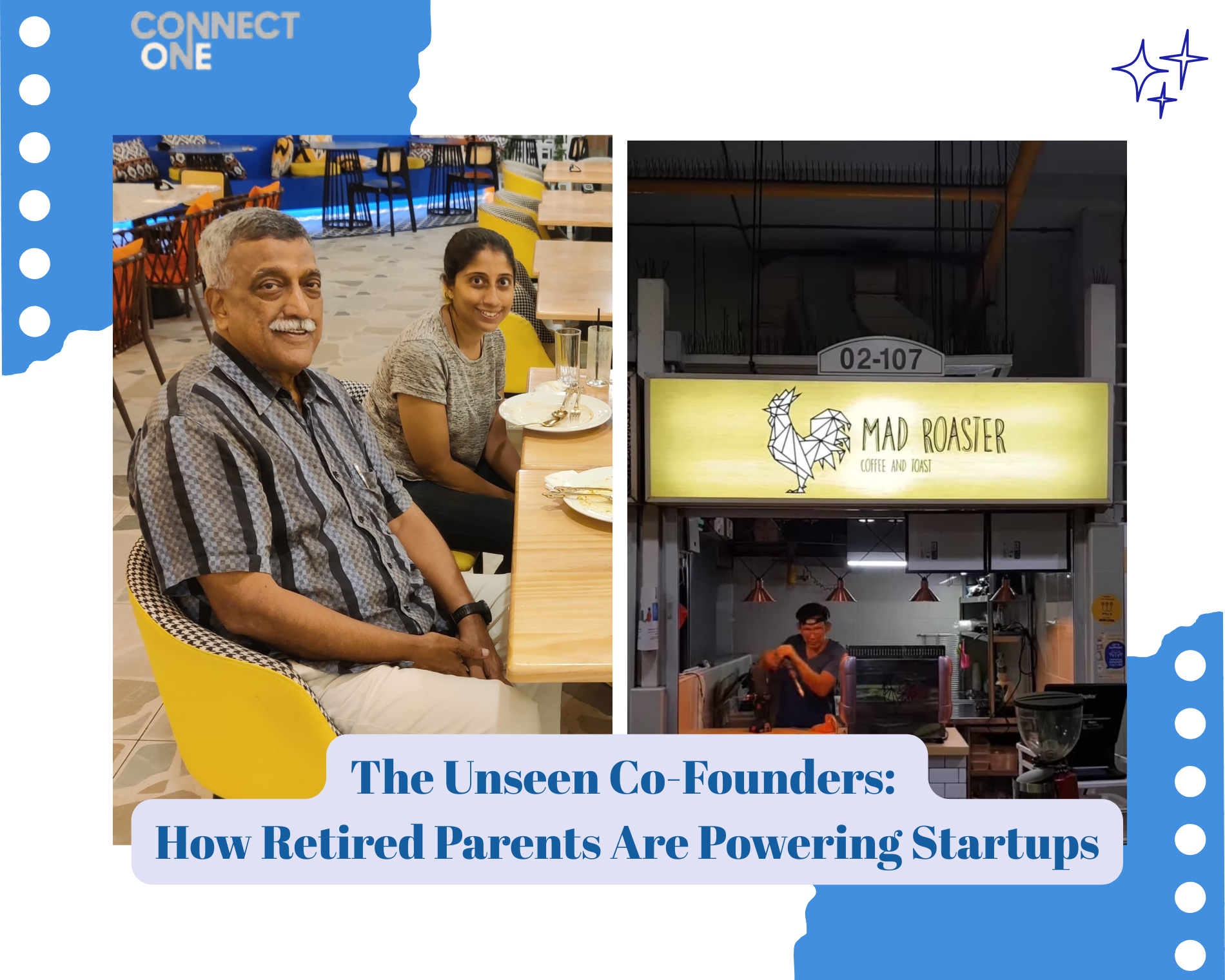
This story unfolds through two founders - Madeline Chan, founder of Mad Roaster, a social enterprise F&B business, and Sugasini Kandiah, founder of Hidden Gems, a recruitment firm - and their fathers, James Chan and Kandiah Subramaniam, who stepped into their children’s startups in ways none of them initially planned.
Together, their experiences reveal something profound about how startups actually survive their earliest years - and where real leverage sometimes comes from.
“I Told Her Not to Do It”
Neither James Chan nor Kandiah Subramaniam expected to work in their children’s businesses.
James was blunt when Madeline told him she wanted to start a café.
“I told her not to do it,” he said. “F&B is very difficult.”
After years of running businesses himself, James understood thin margins and operational fragility. He was retired. He had earned his rest. He told himself clearly that he would not get involved.
Kandiah felt something similar when his daughter Sugasini left a stable career to start a recruitment firm.
Like many parents, his instinct was cautious support - encouragement without direct involvement.
“I retired about 15 years ago,” he said. “I wasn’t interested in working again.”
In both cases, boundaries were drawn early. And in both cases, reality intervened.
When “Just One Problem” Changes Everything
For Mad Roaster, the turning point came almost immediately.
The first outlet ran into a potentially fatal issue: insufficient electrical power to run an espresso machine within regulatory limits - the kind of problem that doesn’t show up in business plans but can stop a business cold.
Madeline called her father, an electrical engineer by training.
“She asked me to help with the problem,” James recalled. “So I thought of something different.”
Instead of pushing for approvals or overloading the system, he engineered a workaround: a battery-powered solution that charged overnight and ran the espresso machine during the day.
“It didn’t overload the power consumption limit,” he said. “That’s how it started.”
For Hidden Gems, the entry point was less dramatic - but no less foundational.
Sugasini needed someone to handle payroll, compliance, and administrative setup in Malaysia.
“She said she needed an administrator,” Kandiah recalled. “I said, fine, I’ll help.”
In both cases, what started as a narrow intervention quietly became something much deeper.
From Helping Out to Becoming Operationally Essential
Neither father stepped in with a title or a formal role. Their involvement expanded organically, driven by necessity rather than design.
“At one stage, my involvement was very heavy,” James said.
That stage came when Madeline was pregnant. Running an early-stage café business while physically exhausted wasn’t sustainable.
“She couldn’t carry on running the business,” he said. “So I stepped in.”
During that period, James wasn’t just covering gaps. He was organising operations, putting in processes, managing people, and ensuring quality didn’t slip.
Kandiah experienced something similar - albeit in a different context.
What began as “basic admin” quickly turned into end-to-end responsibility for payroll, statutory contributions, company setup, and compliance.
“I had people doing this for me before,” he laughed. “Now I have to be hands-on.”
Despite decades in a multinational corporation, the work required humility - and presence.
“She’s the Boss. I Decided That Very Early On.”
One striking similarity across both families was how early the fathers decided where authority would sit.
“She’s still the boss,” James said. “She makes the final decision. I can advise.”
Kandiah came to the same conclusion independently.
“I decided very early on - she’s the boss,” he said. “She makes the decisions. I execute.”
That mindset removed ego from the equation. It also made disagreements survivable.
Both fathers advise freely, disagree openly, and then step back. The business belongs to their daughters - and everyone knows it.
Knowing When Experience Helps - and When It Doesn’t
James is candid about the limits of his relevance.
“The world has changed,” he said. “The time I was running a business and now - very different.”
Mad Roaster serves a younger demographic. Taste profiles, branding, and marketing channels bear little resemblance to what his generation grew up with.
“Our generation likes bitter, strong coffee,” he laughed. “Young people want more flavour, more notes.”
So he steps back.
“When it comes to marketing, product choice, product design, R&D - I leave it to her,” he said. “Even if I don’t agree. I say it, but I don’t insist.”
Kandiah observed a similar generational gap - particularly in how services are sourced.
His instinct is to rely on long-standing relationships and face-to-face trust. His daughter is comfortable finding providers online.
Rather than insisting, he advises - gently - and lets experience speak over time.
Cost Savings That Became the Brand DNA
Some of the most tangible contributions from retired parents show up quietly in operational decisions.
Because of his technical background, James was comfortable buying equipment others would walk away from.
“I dare to purchase something that’s really looking bad,” he said. “Because I know inside, beneath all the grime, it’s actually a good piece of equipment.”
By refurbishing second-hand espresso machines, he saved Mad Roaster 60–70% in capital costs. Over time, those machines became part of the brand itself - hand-designed, wood-panelled, intentionally “naked.”
Madeline later reflected that even if the business could afford external hires today, her parents are inseparable from its DNA.
“They’ve moulded it,” she said. “All our espresso machines are hand-designed by my dad. They’ve become part of the brand.”
What began as cost-saving became differentiation.
Doing the Work No One Else Would Do
When asked what he brings that no hire or consultant could, Kandiah answered immediately.
“I’m available 24/7.”
That availability shows up in small, unglamorous ways: multiple trips to government offices, dealing with paperwork, delivering cakes to early employees, solving problems as they arise.
“You can’t ask a third-party provider to do these things,” he said. “They’ll charge you for everything.”
Sugasini sees the difference clearly.
“My dad is actually a very structured guy,” she said. “He could clearly identify the core KPIs of his role - much better than I could. I suppose that comes from his MNC days.”
And when plans change - as they constantly do in startups - patience becomes the differentiator.
“What no hire or consultant realistically could bring,” she added, “is a willingness to take on odd jobs and be flexible. Very patient with my ever-changing plans.”
When the Founder Nearly Gave Up
There are moments in every startup that never make it into investor updates — the quiet ones where exhaustion sets in and the question is no longer “How do we grow?” but “Can I keep going?”
“At one stage, Madeline was burnt out and wanted to give up,” James shared.
To a first-time founder, burnout can feel terminal — a sign that something is fundamentally broken. To someone who has scaled businesses before, it often looks like a familiar threshold.
“I saw that you had to push beyond that,” he said. “Once you break through that point, then you can cruise.”
They pushed. They crossed it. The business stabilised.
This kind of judgment — knowing when to stop and when to persist — is almost impossible to outsource. It comes only from lived experience.
The Unexpected Connection
For both fathers, working with their children brought unexpected meaning.
“Usually, a parent and child drift apart,” James said. “She does her thing, I do my thing.”
Working together changed that.
“We spend a lot of time together,” he said. “That connection - that’s a big benefit.”
Kandiah reflected on role reversal with a smile.
“Here was a girl I doted on when she was young,” he said. “Now the role is reversed. I listen to her and say, ‘Yes, boss.’”
There is pride in that statement - and acceptance.
More Than Help - A Quiet Form of Co-Founding
None of these parents call themselves co-founders.
But look closely at what they provide: operational backbone, emotional runway, capital efficiency, availability, and care.
They are not doing it for equity.
They are not doing it for status.
They are doing it because they can - and because it matters.
In an ecosystem obsessed with speed and novelty, retired parents offer something rarer: steadiness.
And sometimes, the most powerful co-founder isn’t on your cap table - but quietly beside you, ready to help when you need it most.